
Buying guideUpdated Nov 1, 2026
How to import a Chinese electric car into Norway (2026)
CRAVEUO EV Export · Sources last checked 2026-11-01 · General information, not legal advice. We do not clear customs in Norway. Nothing here is a promise or a quote.
Quick answer
Norway is open to private imports, but a car without EU type approval must pass individual approval, and the road authority warns that this can be hard for cars from outside Europe. Tax is the easier part in 2026: electric cars are VAT-free up to NOK 300,000 and pay a weight-based part of the one-off tax. The VAT limit is proposed to fall to NOK 150,000 on 1 January 2027. So the clearance date matters, and so does the version of the car.
What you pay in 2026
Customs duty
The road authority calls the step customs clearance "even if you do not pay customs", and Tolletaten's car page lists only VAT and the one-off tax. It does not quote a rate for cars
VAT
No VAT up to NOK 300,000. 25% on the part above that. Applies to new and used cars not registered in Norway before (Tolletaten, updated 19 Aug 2026)
One-off registration tax
Electric passenger cars in group A pay only the weight part: NOK 12.71 per kg above 500 kg (Tolletaten)
Scrap deposit tax
NOK 2,400 (Skatteetaten)
Greenhouse gas tax
Per kg of refrigerant. A car usually holds about 1 kg (Skatteetaten)
VAT base
Price plus freight and insurance to the Norwegian border (Skatteetaten)
| Item | Rule |
|---|---|
| Customs duty | The road authority calls the step customs clearance "even if you do not pay customs", and Tolletaten's car page lists only VAT and the one-off tax. It does not quote a rate for cars |
| VAT | No VAT up to NOK 300,000. 25% on the part above that. Applies to new and used cars not registered in Norway before (Tolletaten, updated 19 Aug 2026) |
| One-off registration tax | Electric passenger cars in group A pay only the weight part: NOK 12.71 per kg above 500 kg (Tolletaten) |
| Scrap deposit tax | NOK 2,400 (Skatteetaten) |
| Greenhouse gas tax | Per kg of refrigerant. A car usually holds about 1 kg (Skatteetaten) |
| VAT base | Price plus freight and insurance to the Norwegian border (Skatteetaten) |
Some summaries (search excerpt, not opened) say electric cars pay no one-off tax. That is out of date: the customs page above shows the weight part. As our own arithmetic, a car counted at 2,000 kg pays NOK 19,065 at the 2026 rate.
The EU's extra duties on China-built cars (Regulation 2024/2754 (search excerpt, not opened)) apply to imports into the EU. Norway is in the EEA, not the EU, and we found nothing that extends them to Norway.
What may change on 1 January 2027
The 2027 budget proposal cuts the VAT-free limit from NOK 300,000 to NOK 150,000, subject to approval by the EFTA Surveillance Authority. Parliament also asked for a further NOK 150,000 cut in the 2028 budget. We could not open the government's 2027 rate table, so we do not have the 2027 weight rate. Do not sign on the 2026 figures if the car will clear in 2027.
Approval: the real barrier
All imported vehicles without EU type approval must be individually approved before first registration in Norway. The same page says it can be difficult to get cars from outside Europe approved.
For a new car, the rules are in the vehicle regulation (bilforskriften), chapter 4:
- Section 4-1: a car counts as new if it has never been registered.
- Section 4-3: EU individual approval is available for a car that meets Article 44 of Regulation 2018/858.
- Section 4-4: national individual approval. The car must meet each requirement area in Annex 1, with testing and documents following EU type-approval rules.
- Test evidence can come from a technical service designated by any EEA country.
- We saw no limit on the number of cars in sections 4-1 to 4-6.
For a China-market car, that means someone must prove each area with test reports. China's GB and GB/T approval is not listed as a substitute in what we read. We read that as a large cost per car, and possibly a dead end if the manufacturer will not supply data. We did not find a public fee or a typical test budget.
Documents must be in Norwegian, Swedish, Danish or English, or translated (section 2-3). A CoC, if you have one, applies to one chassis number.
Official sales and the China version
Some Chinese brands sell through official channels in Norway, including XPeng (search excerpt, not opened). NIO has also been present here since 2021 (search excerpt, not opened). Their cars are built to European specification. A China-market car of the same name is a different product for approval, charging and software. Ask the local brand about warranty before you consider a China-market car.
Used cars and charging
Used car from outside the EU/EEA
Must meet the requirements for its first-registration date. Bilforskriften applies from 15 Sept 2012
Ownership proof
A public document is required for imports from outside the EU/EEA
Tax data
Must come from the manufacturer or an approved laboratory
Foreign plates
Up to 30 days after crossing the border, if insured and roadworthy
Connectors
EU charging rules (Type 2 and CCS2) are due to apply through the EEA (search excerpt, not opened). We found no Norwegian rule on GB/T and no date
Steering
No rule found. China-market cars are left-hand drive
| Topic | Detail |
|---|---|
| Used car from outside the EU/EEA | Must meet the requirements for its first-registration date. Bilforskriften applies from 15 Sept 2012 |
| Ownership proof | A public document is required for imports from outside the EU/EEA |
| Tax data | Must come from the manufacturer or an approved laboratory |
| Foreign plates | Up to 30 days after crossing the border, if insured and roadworthy |
| Connectors | EU charging rules (Type 2 and CCS2) are due to apply through the EEA (search excerpt, not opened). We found no Norwegian rule on GB/T and no date |
| Steering | No rule found. China-market cars are left-hand drive |
Models to ask about
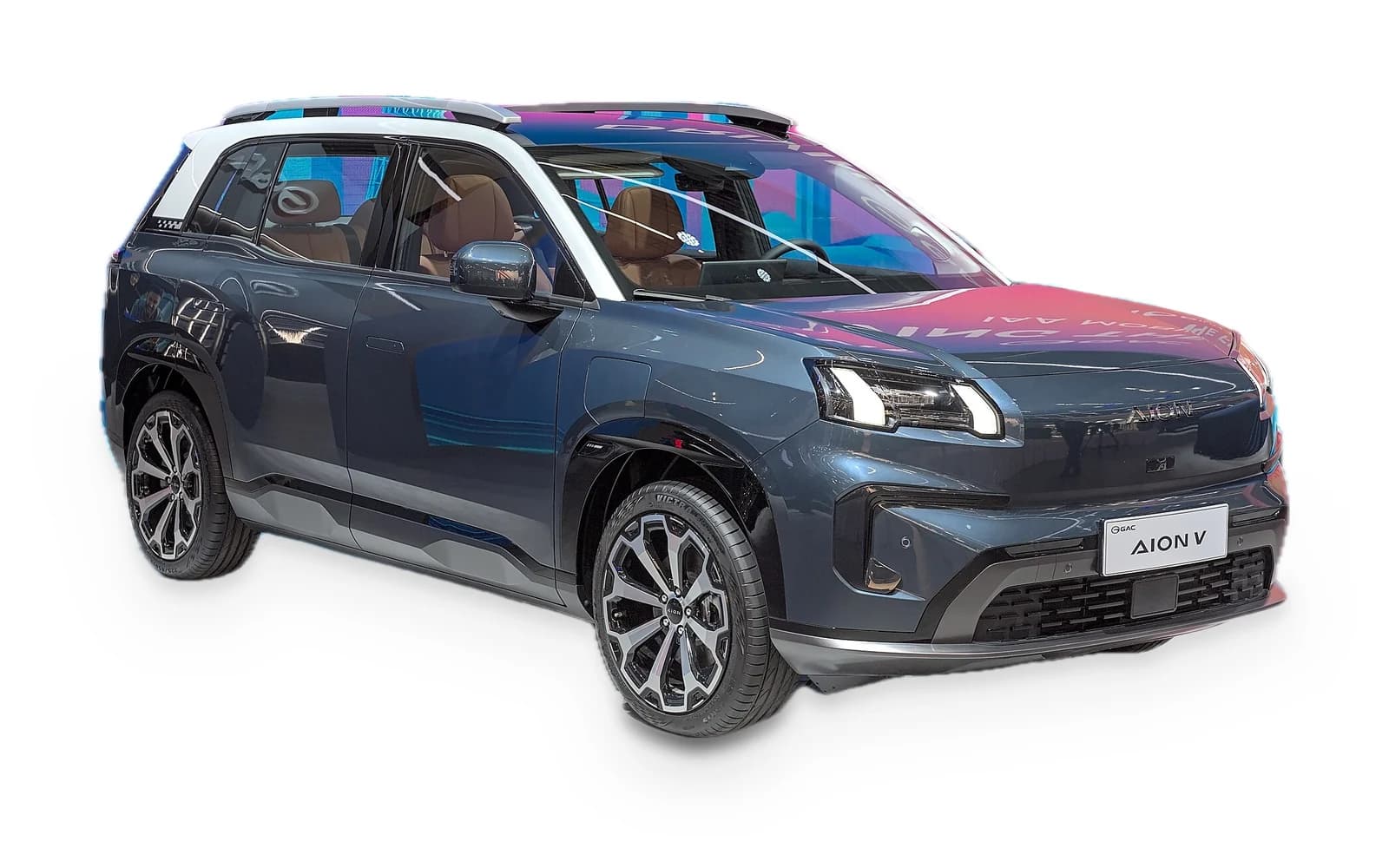
China guide price, not a delivered price. It is pure electric.
Type: Battery-electric
China guide price from: ¥109,800
| Model | Type | China guide price from |
|---|---|---|
| Aion V | Battery-electric | ¥109,800 |
Send your country, model and version through the inquiry form. We tell you whether we can supply that car before any contract.
How an order works
- Contact a traffic station or a technical service, and ask which approval path fits the exact version.
- Find out whether the manufacturer will give a CoC or test data.
- Sign with the licensed Chinese export company only after step 2. Nothing is paid before it is signed, and payment goes only to the company account on the invoice.
- Declare the car at the border, pay VAT, and report to a customs station.
- Pass approval at a traffic station, then pay the one-off tax and scrap deposit to Skatteetaten.
- Register the car with Statens vegvesen.
Common questions
Can a private person import a car from China?
Do electric cars still get free VAT?
Is the one-off tax zero?
Will a China-market car pass?
Does the EU's tariff apply?
Cars to start with
Want one of these cars shipped to your country?
Tell us your country and the version; we reply within one working day with an FOB reference price and the export route.
Sources (checked 2026-11-01)
- Tolletaten: electric vehicles, updated 2026-08-19
- Tolletaten: importing a car, updated 2026-02-05
- Statens vegvesen: individual approval
- Statens vegvesen: how a vehicle is approved
- Statens vegvesen: imported from outside the EU/EEA
- Statens vegvesen: import of vehicles
- Bilforskriften, chapter 4
- Skatteetaten: other taxes on import
- Regnskap Norge: 2027 budget proposal, trade body
- Electrive: AFIR interview (search excerpt, not opened), trade press, 2024-05-06
- XPeng Norway (search excerpt, not opened)
- EU Regulation 2024/2754 (search excerpt, not opened)
This guide is not legal or customs advice; the destination's customs and a licensed broker decide.